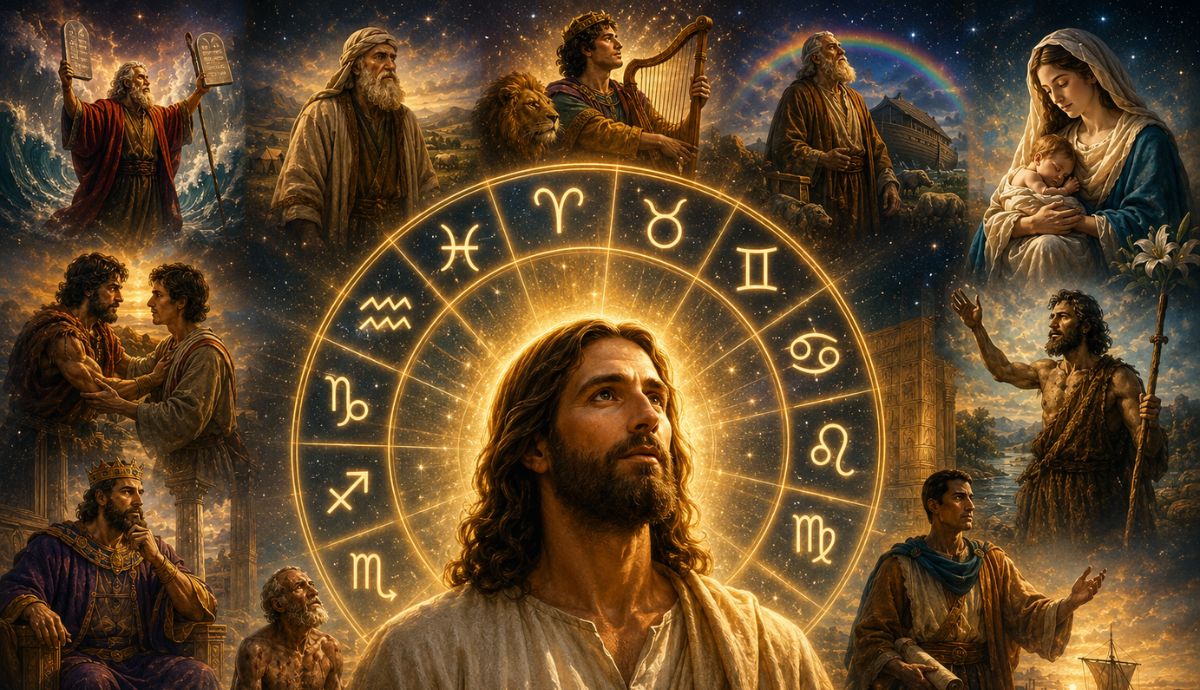
Throughout history, people have searched the heavens for meaning. Long before astrology became associated with newspaper horoscopes, the zodiac served as a symbolic language through which ancient civilizations interpreted nature, human behavior, and the seasonal nature of time. Each of the twelve zodiac signs came to represent a universal archetype such as the warrior, the builder, the seeker, the healer, the ruler, and the redeemer. These archetypes encapsulate recurring patterns found throughout myth, religion, and human experience.
The Bible emerged within this same symbolic world. Its authors lived in cultures deeply familiar with celestial imagery, seasonal cycles, sacred animals, and allegorical storytelling. Although the Scriptures do not present themselves as a hidden zodiac code, they are rich with symbols that have invited symbolic interpretation for centuries. From lions and lambs to serpents, fish, wheat, water, and stars, biblical narratives frequently employ imagery that resonates with archetypal traditions found throughout the ancient world.
For this reason, many astrologers, mystics, and students of theology have noticed intriguing parallels between biblical figures and the twelve zodiac archetypes. These connections are not intended to suggest that the Bible secretly teaches astrology, nor are they accepted as historical conclusions by mainstream biblical scholarship. Rather, they offer a symbolic lens through which familiar stories can be viewed from a fresh perspective.
Archetypes are recurring patterns that transcend any single culture or religion. Carl Jung described them as universal images embedded within the collective unconscious, while mythologists such as Joseph Campbell demonstrated how the same heroic journeys and symbolic characters appear across civilizations separated by thousands of years. Whether one approaches the Bible as sacred history, literature, or mythology, its stories are filled with these timeless patterns.
There are many traditional esoteric interpretations that connect biblical stories, symbols, and figures with the zodiac signs. However, these are generally symbolic correspondences rather than established historical facts. The Bible was written across many centuries and cultures, while the familiar 12-sign zodiac system developed primarily through Babylonian and Hellenistic traditions.
That said, the symbolic parallels are interesting, especially if you look at the Bible as part of the broader world of ancient mythology, archetypes, and cosmic symbolism.
Here are some of the commonly proposed connections:
| Zodiac Sign | Biblical Symbol / Story Often Associated | Reason for the Connection |
| ♈ Aries | Ram, Abraham’s ram sacrifice, Moses’ shofar | The ram symbolizes sacrifice, covenant, and divine provision. |
| ♉ Taurus | Golden calf, oxen, bulls in sacrifice | The bull represents strength, fertility, and earthly power. |
| ♊ Gemini | Jacob and Esau, Cain and Abel, paired figures | Gemini represents twins, duality, and opposing forces. |
| ♋ Cancer | The “waters,” protection, the Ark of Noah | Cancer is associated with water, shelter, and nurturing. |
| ♌ Leo | Lion of Judah, Daniel’s lions’ den | The lion symbolizes kingship, courage, and divine authority. |
| ♍ Virgo | Virgin Mary | Virgo means “virgin”; Mary is the strongest Christian association. |
| ♎ Libra | Scales of judgment, justice imagery | Libra represents balance, law, and weighing of deeds. |
| ♏ Scorpio | Serpent imagery, temptation, death/rebirth themes | Scorpio symbolism relates to transformation and hidden forces. |
| ♐ Sagittarius | Archers, Ishmael, warriors | Sagittarius represents the archer, pursuit, and divine mission. |
| ♑ Capricorn | Goat symbolism, scapegoat of Yom Kippur | The goat carries sin away in the wilderness ritual. |
| ♒ Aquarius | Water bearer, servant carrying water, baptism | Aquarius symbolism connects to water, renewal, and spiritual awakening. |
| ♓ Pisces | Fish, disciples as fishermen, Jesus miracles | Fish became a major Christian symbol. |
The following interpretations are therefore best understood as symbolic correspondences rather than hidden codes. They invite readers to explore how biblical narratives, astrology, mythology, and psychology often converge around the same enduring truths about human nature.
Note: This article explores symbolic and archetypal parallels between biblical narratives and the zodiac. It is not intended to suggest that the Bible secretly teaches astrology or that these interpretations reflect mainstream Christian theology or biblical scholarship. Instead, it examines how recurring archetypes appear across different symbolic traditions.
1. Aries ♈ as Moses: The Pioneer and Liberator

As the first sign of the zodiac, Aries represents beginnings, courage, initiative, and the willingness to venture into the unknown. Symbolized by the ram, Aries embodies the force that starts a new cycle, confronting obstacles with determination and leading others toward uncharted territory.
Few biblical figures reflect this pioneering spirit more vividly than Moses.
His story begins with a reluctant shepherd but quickly transforms into one of history’s greatest liberation narratives. Called by God through the burning bush, Moses accepts the daunting task of confronting Pharaoh (the most powerful ruler of his age) and demanding the freedom of the Israelites. Like the Aries archetype, he steps forward when others hesitate, becoming the catalyst for an entirely new chapter in Israel’s history.
The symbolism surrounding Moses also echoes traditional Aries imagery. Fire, one of Aries’ defining elements, appears in the miraculous burning bush where Moses receives his calling. Later, the “shofar” or ram’s horn becomes a sacred instrument used to gather the people, announce holy festivals, and proclaim moments of divine significance. The ram itself also appears prominently in Scripture, most famously as the substitute sacrifice provided to Abraham, further reinforcing its association with faith, renewal, and divine purpose.
From an esoteric perspective, Moses occupies an especially fascinating position in relation to the astrological ages. Some symbolic traditions suggest that his leadership represents humanity’s transition from the Age of Taurus to the Age of Aries. Whether or not this interpretation reflects historical intent, Moses unquestionably stands as the initiator of a new covenant, a new identity, and a new direction for an entire nation.
Like every archetype, Moses cannot be reduced to a single zodiac sign. His ascent of Mount Sinai recalls Capricorn’s devotion to law and structure, while his role as mediator between God and Israel reflects Virgo’s spirit of humble service. Yet above all else, Moses remains the pioneer, the courageous leader who dares to take the first step into an uncertain future. In that respect, he is one of Scripture’s clearest expressions of the Aries archetype.
2. Taurus ♉ as Abraham: The Patriarch, the Covenant, and the Promise of the Land

If Moses represents the courage to begin, Abraham represents the patience to establish enduring foundations.
Taurus is the zodiac’s great builder. As an earth sign symbolized by the bull, it is traditionally associated with stability, fertility, prosperity, livestock, agriculture, and the cultivation of lasting security. These themes permeate Abraham’s story from beginning to end.
Rather than conquering kingdoms, Abraham receives a promise. God establishes a covenant that centers on descendants, abundant flocks, and the inheritance of the Promised Land. Throughout Genesis he is described as a man of considerable wealth, measured not by military victories but by his cattle, sheep, silver, and gold. His life revolves around tending flocks, building altars, raising a family, and laying the foundations for a nation that will outlive him.
This emphasis on permanence distinguishes Abraham from Moses. Moses leads people through the wilderness toward an uncertain future; Abraham plants the seeds of a civilization rooted in faith, family, and inheritance. His legacy is not movement but establishment, making him a fitting expression of Taurus’ patient, enduring nature.
The symbolism becomes even more intriguing when viewed alongside the episode of the Golden Calf. Historically, the calf reflects the widespread bull worship practiced throughout Egypt and the ancient Near East, and most biblical scholars interpret the story as a condemnation of idolatry rather than astrology. Yet esoteric traditions have long suggested another layer of meaning.
According to the concept of the astrological ages, the bull represents the fading Age of Taurus, while Moses and the ram symbolize the emergence of the Age of Aries. In this symbolic reading, the destruction of the Golden Calf marks not only the rejection of idolatry but also the passing of one spiritual era into another.
Whether accepted as history or appreciated simply as mythology, this interpretation illustrates how biblical stories and astrological symbolism often intersect in surprising ways. Abraham, with his covenant, livestock, fertile land, and enduring legacy, remains one of the Bible’s strongest expressions of the Taurus archetype as being the patient builder whose faith creates foundations that endure for generations.
3. Gemini ♊ as Jacob: The Twin, the Trickster, and the Search for Identity

If Taurus establishes foundations, Gemini introduces movement, dialogue, and transformation. Represented by the Twins, Gemini symbolizes duality, communication, adaptability, and the tension between opposing aspects of human nature. No biblical figure reflects these themes more completely than Jacob.
Jacob’s story begins with one of the Bible’s most memorable images. Born moments after his twin brother Esau, he enters the world grasping Esau’s heel, foreshadowing a lifetime defined by rivalry, reversal, and transformation. Throughout Scripture, the brothers embody contrasting ways of engaging with life. Esau is impulsive, physical, and instinctive; the hunter of the open fields. Jacob is thoughtful, strategic, and patient, relying on wit rather than strength.
These opposing personalities capture the essence of Gemini’s twin symbolism. Rather than representing good versus evil, the twins illustrate the complementary forces that exist within every person: instinct and intellect, action and reflection, impulse and foresight.
Jacob repeatedly succeeds through cleverness and communication. He negotiates Esau’s birthright, disguises himself to receive Isaac’s blessing, and later prospers while serving Laban through careful planning and ingenuity. Whether viewed as wisdom or manipulation, his victories are achieved through adaptability rather than force.
His greatest transformation, however, occurs not through deception but through struggle. After wrestling through the night with a mysterious divine being, Jacob receives a new name: Israel. The change symbolizes more than a new identity, it also marks the integration of the divided self. The ambitious younger brother becomes the father of a nation, illustrating Gemini’s capacity for continual growth and reinvention.
Jacob’s famous dream of a ladder reaching from earth to heaven further reinforces this symbolism. Like Gemini, often associated with communication and exchange, the ladder becomes a bridge between the earthly and the divine, suggesting that understanding arises when seemingly separate worlds are connected.
Viewed symbolically, Jacob represents the Gemini archetype as the seeker of identity. His life reminds us that growth often comes through embracing life’s contradictions rather than trying to eliminate them.
4. Cancer ♋ as Noah: The Guardian and the Sacred Refuge

Where Gemini explores the world through the mind, Cancer turns inward toward home, family, and preservation. Symbolized by the crab, Cancer represents protection, emotional security, ancestry, and the instinct to safeguard life during times of uncertainty.
No biblical story reflects these themes more clearly than that of Noah.
The Ark is far more than a vessel built to survive a flood. Symbolically, it is humanity’s first great sanctuary; a floating home that preserves life while the old world passes away beneath the waters. Within its walls are Noah’s family and representatives of every living creature, protected from the chaos outside until creation can begin anew.
Like the shell of the crab, the Ark encloses and shelters what is most precious.
Noah’s calling is not to conquer enemies or establish an empire. His mission is preservation. He protects his family, safeguards the future of creation, and faithfully carries life through one of Scripture’s greatest catastrophes. His legacy is measured not by power but by responsibility.
Water, Cancer’s traditional element, reinforces this symbolism. Throughout the flood narrative, overwhelming waters represent chaos, uncertainty, and forces beyond human control. Noah does not defeat the flood through strength; he endures it through faith, preparation, and steadfast care for those entrusted to him.
After the waters recede, God establishes a covenant with Noah and places the rainbow in the sky as its sign. Unlike covenants centered on conquest or kingship, this promise emphasizes mercy, continuity, and the preservation of future generations.
Cancer reminds us that civilizations endure not only because of heroes who conquer, but because of guardians who protect. Noah embodies this enduring archetype, demonstrating that some of history’s greatest acts of courage are quiet acts of stewardship.
5. Leo ♌ as King David: The Lion, the King, and the Courage of the Heart

If Cancer preserves the nation, Leo gives it a king.
Represented by the lion, Leo symbolizes courage, nobility, leadership, creativity, and the confidence to stand at the center of one’s calling. Few biblical figures embody these qualities more fully than King David.
David’s rise from shepherd to king follows one of the Bible’s most enduring heroic journeys. Though the youngest of Jesse’s sons, he is chosen by the prophet Samuel to become Israel’s future ruler, demonstrating that true greatness arises from character rather than status.
His defining moment comes in his confrontation with Goliath. While seasoned warriors hesitate before the Philistine giant, David steps forward armed only with a sling, unwavering faith, and the courage to face overwhelming odds. The episode captures Leo’s highest expression: the willingness to act boldly when others retreat.
David’s legacy also establishes the royal symbolism of Judah. Jacob had earlier described Judah as a lion’s cub, and David’s dynasty eventually gives rise to the title “Lion of Judah,” later applied to the Messiah. Throughout Scripture, the lion becomes a symbol of righteous authority, courage, and divine kingship.
Yet David reflects another side of Leo often overlooked: creativity. He is not only a warrior but also a poet and musician whose Psalms express joy, grief, repentance, and praise with remarkable emotional honesty. Leo governs the heart, and David’s greatness lies as much in his willingness to reveal it as in his victories on the battlefield.
Like every archetype, Leo possesses a shadow. David’s affair with Bathsheba and his abuse of royal authority reveal how power can become corrupted by pride and desire. Unlike many rulers, however, David responds with genuine repentance when confronted by the prophet Nathan. His humility ultimately becomes as important as his courage.
For this reason, the Bible describes David as “a man after God’s own heart.” More than any crown or military triumph, it is the condition of his heart that defines his legacy. In David, the Leo archetype reminds us that true leadership requires not only strength but also humility, creativity, and the willingness to grow beyond one’s failures.
6. Virgo ♍ as The Virgin Mary: Humility, Service, and the Sacred Harvest

As the zodiac turns from kingship to service, Virgo represents humility, devotion, and the quiet work of nurturing life. Symbolized by the maiden, Virgo has long been associated with purity, cultivation, healing, and the patient preparation that allows something greater to emerge.
No biblical figure embodies these qualities more naturally than the Virgin Mary.
The very name Virgo means “virgin,” making the connection immediately apparent. Yet Mary’s significance extends beyond the miracle of the virgin birth. Throughout the Gospels, she exemplifies the archetype of faithful service. When the angel Gabriel announces that she will bear the Messiah, Mary responds not with ambition or self-importance, but with humble acceptance of a calling that will forever change her life.
Ancient depictions of Virgo often portray the maiden holding a sheaf of wheat, symbolizing harvest, nourishment, and the patient cultivation of life. Mary reflects this symbolism by becoming the vessel through which Christians believe salvation enters the world. Just as a harvest begins with a single seed, the birth of Christ becomes the beginning of a new spiritual covenant.
Her influence is never rooted in political authority or military power. Instead, Mary serves quietly behind the scenes, faithfully supporting her son from his birth in Bethlehem to his crucifixion in Jerusalem. She demonstrates that some of history’s most profound transformations begin not through conquest, but through compassion, obedience, and unwavering faith.
Virgo reminds us that greatness is often found in service rather than recognition. Through Mary’s humility, the archetype reveals that preparing the world for something sacred can be every bit as heroic as ruling a kingdom.
7. Libra ♎ as King Solomon: The Scales of Wisdom and Justice
If David represents the courage to rule, Solomon represents the wisdom to rule well.
Libra, symbolized by the scales, is the zodiac’s great archetype of balance, justice, diplomacy, and discernment. Rather than seeking victory through force, Libra seeks harmony through understanding. Few biblical figures embody this ideal more completely than King Solomon.
Solomon’s reign is remembered not primarily for military conquest but for wisdom. His most famous judgment, the dispute between two women claiming the same child, demonstrates his remarkable ability to look beyond appearances and uncover the truth hidden beneath conflicting claims. Like the scales themselves, Solomon carefully weighs opposing perspectives before rendering judgment.
This concern for balance extends throughout his kingdom. His name is linked to the Hebrew word shalom, meaning peace, completeness, and harmony. Under his rule, Israel experiences an era of prosperity, diplomacy, and cultural exchange rather than continual warfare.
One of Solomon’s greatest achievements is the construction of the Temple in Jerusalem. More than an architectural masterpiece, the Temple symbolizes divine order as a carefully proportioned meeting place between heaven and earth. Its harmony and symmetry reflect Libra’s belief that beauty arises when every part exists in proper relationship with the whole.
Yet Solomon’s story also reveals Libra’s shadow. In his later years, political alliances and numerous marriages gradually divide his loyalties, illustrating how the pursuit of harmony can sometimes become compromise without conviction. His life reminds us that genuine balance requires not only fairness, but also steadfast commitment to enduring principles.
Through Solomon, Libra teaches that the highest form of leadership is not domination, but the ability to reconcile opposing forces and establish justice rooted in wisdom.
8. Scorpio ♏ as Job: Death, Transformation, and the Phoenix
Following Libra’s search for balance, Scorpio carries the soul into its deepest transformation.
Represented by the scorpion and, in later esoteric traditions, the eagle and the phoenix, Scorpio symbolizes death, rebirth, hidden truths, and the profound changes that arise through suffering. No biblical figure reflects this journey more powerfully than Job.
At the beginning of his story, Job appears to possess everything a person could desire: wealth, family, health, and honor. Yet in rapid succession he loses nearly all of it. His possessions vanish, his children perish, his body is afflicted, and even his closest companions question his integrity.
Symbolically, Job experiences a kind of death, not of the body, but of identity. Everything upon which he built his life is stripped away, forcing him to confront the deepest questions of existence.
Unlike his friends, who insist upon simple explanations for suffering, Job refuses easy answers. He wrestles honestly with grief, doubt, and mystery, refusing to abandon his search for truth even when no satisfying explanation is given. When God finally speaks, the response is not a justification for suffering but a revelation of creation’s vastness and complexity. Job discovers that wisdom sometimes lies not in possessing answers, but in recognizing the limits of human understanding.
This journey closely mirrors the Scorpio archetype. Like the mythical phoenix rising from its ashes, Job emerges from devastation transformed rather than defeated. His restoration is not merely the recovery of what was lost, it is the birth of a deeper relationship with the divine, forged through endurance rather than certainty.
Scorpio reminds us that transformation rarely comes through comfort. More often, it is life’s darkest seasons that strip away illusion, reveal hidden strength, and prepare the soul for renewal.
9. Sagittarius ♐ as Paul the Apostle: The Seeker and Messenger of Truth
After Scorpio’s journey through death and transformation comes Sagittarius, the archetype of discovery, wisdom, and the pursuit of higher truth. Represented by the archer, Sagittarius symbolizes the desire to look beyond familiar horizons in search of meaning.
Few biblical figures embody this restless spirit more completely than Paul the Apostle.
Paul’s life is defined by transformation and movement. Once a zealous persecutor of the early Church, he undergoes a dramatic conversion on the road to Damascus that completely redirects his purpose. Like an archer changing his aim, Paul sets his sights on a new mission, dedicating his life to spreading the message of Christ throughout the Roman world.
His missionary journeys take him across Asia Minor, Greece, and eventually Rome, bringing him into dialogue with diverse cultures, philosophies, and religious traditions. Rather than confining his message to one nation, Paul argues that the Gospel is meant for all humanity. This universal outlook reflects Sagittarius’ association with exploration, cultural exchange, and expanding one’s understanding beyond familiar boundaries.
Paul was not only a traveler but also a teacher. His epistles wrestle with profound questions concerning faith, morality, grace, and human nature. More than offering simple instruction, they invite readers to think deeply about the relationship between humanity and the divine.
Like every archetype, Sagittarius has its challenges. Conviction can become dogmatism, and zeal can become intolerance. Paul’s writings continue to inspire debate precisely because of the passion with which he defended his beliefs. Yet his life ultimately illustrates Sagittarius at its highest expression: the relentless pursuit of truth and the willingness to devote one’s life to sharing it with the world.
10. Capricorn ♑ as Joseph: The Mountain Climber and Faithful Steward
If Sagittarius seeks wisdom, Capricorn puts wisdom into practice.
Represented by the mountain goat, Capricorn symbolizes discipline, perseverance, responsibility, and the slow ascent toward lasting achievement. No biblical figure reflects this steady determination more clearly than Joseph.
Joseph’s life is a story of hardship transformed into purpose. Betrayed by his brothers, sold into slavery, falsely accused, and imprisoned, he repeatedly faces setbacks that might have broken a lesser person. Instead, every trial becomes another step in his ascent.
His rise from prisoner to Pharaoh’s chief administrator mirrors Capricorn’s climb toward the summit. Joseph earns authority not through privilege but through competence, patience, and unwavering integrity. When Egypt faces seven years of famine, he develops a long-term plan to store grain during years of abundance, preserving not only Egypt but also the very family that had once rejected him.
Capricorn is often associated with legacy, and Joseph’s legacy extends far beyond his own success. His wisdom preserves the lineage of Israel and demonstrates that true leadership consists not in accumulating power but in using it responsibly for the benefit of others.
Joseph’s story also echoes the symbolism of the biblical scapegoat, which carries away the burdens of the people. In different ways, both figures illustrate Capricorn’s willingness to bear responsibility for the sake of a greater good.
His journey reminds us that greatness is rarely achieved overnight. Like the mountain goat, Joseph reaches the summit one difficult step at a time.
11. Aquarius ♒ as John the Baptist: The Water Bearer and Herald of a New Age
As Capricorn establishes enduring structures, Aquarius announces the future.
Symbolized by the water bearer, Aquarius represents awakening, innovation, renewal, and the sharing of knowledge that transforms society. Although Aquarius is an air sign, the water it pours symbolizes spiritual life, wisdom, and renewal offered to humanity.
John the Baptist embodies this archetype with remarkable clarity.
Appearing in the wilderness outside the religious establishment, John challenges people to prepare for a new era. His ministry centers on baptism, a symbolic cleansing through water that invites individuals to leave behind their old lives and embrace spiritual transformation.
John’s message is revolutionary not because he seeks power for himself, but because he prepares the way for someone greater. Like the water bearer, he distributes a gift that does not belong to him, calling others toward renewal while pointing beyond himself.
His unconventional lifestyle and fearless criticism of political and religious authorities further reflect Aquarius’ independent spirit. John stands outside existing systems, urging people to examine tradition, repent, and embrace a new vision for the future.
Many students of biblical symbolism also note Jesus’ instruction to his disciples to follow “a man carrying a pitcher of water” before the Last Supper. While mainstream scholarship does not interpret this as a zodiac reference, esoteric traditions have long regarded it as an intriguing parallel to the image of Aquarius.
Whether understood literally or symbolically, John the Baptist remains one of Scripture’s clearest heralds of renewal, a figure who prepares humanity for a profound spiritual transition.
12. Pisces ♓ as Jesus Christ: The Fish and the Redeemer
The zodiac concludes with Pisces, the sign of compassion, sacrifice, forgiveness, and spiritual transcendence. It is fitting that many symbolic interpretations associate this final archetype with Jesus Christ.
More than any other zodiac correspondence, the connection between Christianity and Pisces has endured throughout history. The fish became one of the earliest symbols of the Christian faith, while many esoteric traditions associate the rise of Christianity with the beginning of the Age of Pisces.
Fish imagery appears repeatedly throughout the Gospels. Jesus calls fishermen to become his first disciples, performs miracles involving fish, feeds thousands with loaves and fishes, and describes his followers as “fishers of men.” These recurring images emphasize nourishment, spiritual abundance, and the gathering of humanity into a single community of faith.
At the heart of the Pisces archetype lies compassion. Jesus consistently teaches mercy over vengeance, forgiveness over resentment, and love even for one’s enemies. His ministry reaches the poor, the sick, the outcast, and the forgotten, demonstrating a boundless empathy that transcends social and cultural divisions.
The symbolism of water also reaches its culmination in Christ through baptism, healing, and the promise of spiritual rebirth. Throughout his life, Jesus bridges heaven and earth, inviting humanity into reconciliation with the divine through selfless love and sacrifice.
Whether viewed through theology or archetypal symbolism, Jesus represents the completion of the zodiac’s symbolic journey. Where Aries begins with courage and action, Pisces concludes with compassion and redemption. The cycle ends not in conquest, but in love.
Conclusion: One Story Told Through Twelve Archetypes
Whether these correspondences were intentionally embedded within Scripture or emerged naturally from humanity’s shared symbolic imagination remains a matter of interpretation. Mainstream biblical scholarship does not view the Bible as a coded astrological text, and there is no historical consensus that its authors deliberately structured its narratives around the zodiac.
Yet the parallels remain striking.
Across both astrology and the Bible we encounter the same timeless patterns: the pioneer who begins a journey, the builder who establishes foundations, the seeker who searches for truth, the guardian who protects life, the righteous king, the humble servant, the wise judge, the soul transformed through suffering, the teacher who spreads wisdom, the faithful steward, the herald of renewal, and finally the compassionate redeemer.
Perhaps this is why these stories continue to resonate across cultures and centuries. They speak to something universal within the human experience.
Rather than proving that the Bible secretly teaches astrology or that astrology explains the Bible, these symbolic correspondences remind us that great myths, sacred texts, and spiritual traditions often draw from the same well of archetypal meaning. They use different languages to explore the same enduring questions: Who are we? Why are we here? How do we grow? And what kind of people are we meant to become?
Viewed through that lens, the zodiac and the Bible become less like competing systems and more like two symbolic maps pointing toward the same timeless landscape of the human soul.
Related Posts:
- The School of Philosophy You Live By Based on MBTI type
- The Emotional Damage Each Zodiac Sign Inflicts Upon Others
- The Bright and Dark Side of Each Moon Sign
- 75 Strong Quotes About Love and Life

- Hunter Moon in Taurus – October 2026 Full Moon Horoscope - October 6, 2026
- The 12 Zodiac Signs Dealing With Loneliness - August 15, 2026
- The MBTI Types Dealing with Loneliness - August 7, 2026